

Why Traceability?
Traceability provides consumer confidence in the excellent standards and practices of Canadian dairy farmers to produce the highest quality milk and dairy products. Traceability enables Canadian dairy farmers to demonstrate the responsible stewardship of their animals and the environment.
Watch these videos to hear from farmers about the advantages of traceability.
Trust through traceability
Producer Dylan Stewardson talks about assurances provided by traceability
Food Safety and
Consumer Confidence
Consumers want to know where their food comes and how it’s produced. Canadian dairy farmers work to offer superior quality products while preventing and reducing food safety hazards and risks on their farms. Traceability demonstrates to consumers the commitment of the dairy industry to produce high quality products and provide animals with excellent care.
Consumer confidence with traceability
Producer Ben Loewith discusses why traceability is important for his farm

Right now, in Canada:
100% of all on-farm milk tanks and milk trucks are sampled for milk quality
99.9% of all milk is picked up at the farm every second day
95% of all dairy farms have been inspected in the past two years
70% of dairy farms have a farm plan designed specifically to improve environmental conditions on the farm
*Source: Dairy Farmers of Canada – proAction®
Economic Advantages
The estimated negative economic effect of an animal disease outbreaks is staggering. Costs include lost sales, lost profits, lost consumer demand and market access, as well as costs related to disease control. Many industries are impacted including terminal sites, the processing sector, distribution networks, tourism, and the restaurant industry.
DairyTrace demonstrates source verification of animals and strengthens the reputation of the Canadian dairy sector, supporting the livelihood of producers and processors, including when exporting to countries with high import standards
Building credibility with traceability
Producer Gerrit Damsteegt talks about how traceability protects the dairy value chain
Emergency Preparedness
Knowing where livestock are located provides valuable information to respond to animal disease outbreaks and food safety issues. This allows for a swift and accurate response in the event of a crisis.
Peace of Mind with Traceability
Chris McLaren talks about the role of traceability in preventing and containing disease.
DairyTrace – one system with many advantages
Public Health
Traceability makes it possible to react quickly when food safety is compromised
Animal Health
An effective traceability system means that affected sites and animals can be rapidly identified to contain and prevent disease spread.
Economics
The data collected from DairyTrace can prepare us for challenging times, help protect our economy, as well as strengthen the reputation of the Canadian dairy sector and its products, at home and around the world.
Market Access
Knowing where animals come from, where they are going, and where they die, secures business continuity and supply chain credibility.
Quality
Traceability is one of the six modules of proAction®, a program that enables Canadian dairy farmers to demonstrate responsible stewardship of their animals and the environment to produce safe, high-quality food for consumers.
Prospective
Traceability has the potential to offer other opportunities that not only feed our world safely but bring sustainability to the next level.
How It Works
Traceability is the process of following an item or a group of items – be it animal, plant, food product or ingredient – from one point in the supply chain to another, either backwards or forwards. The concept designed for emergency management to respond quickly to animal health, public health and food safety issues.
Traceability Reporting Requirements
Three pillars of Traceability
Premises Identification
The identification of sites where animals are born, kept, assembled or disposed.
Animal Identification
A unique lifetime identification number applied to each animal (ear tag).
Movement Reporting
Reporting animal movement events using the premises and tag identification numbers.
The Health of Animals Regulations and Food Products Act ensure that dairy foods intended for human consumption can be traced from the consumer’s plate back to the farm of origin. These regulations, along with proAction®, set the traceability standards related to animal identification, tag application, movement and requirements.
Is Traceability Regulated?
Livestock traceability in Canada is guided by regulatory requirements at the Federal level, though both provincial/territorial governments and livestock industry partners collaborate and contribute to the system via mandatory and voluntary approaches
Everyone who owns or has the possession, care or control of dairy cattle must record and report the following information to DairyTrace:
- animal identity
- movement
- location
- custodianship information

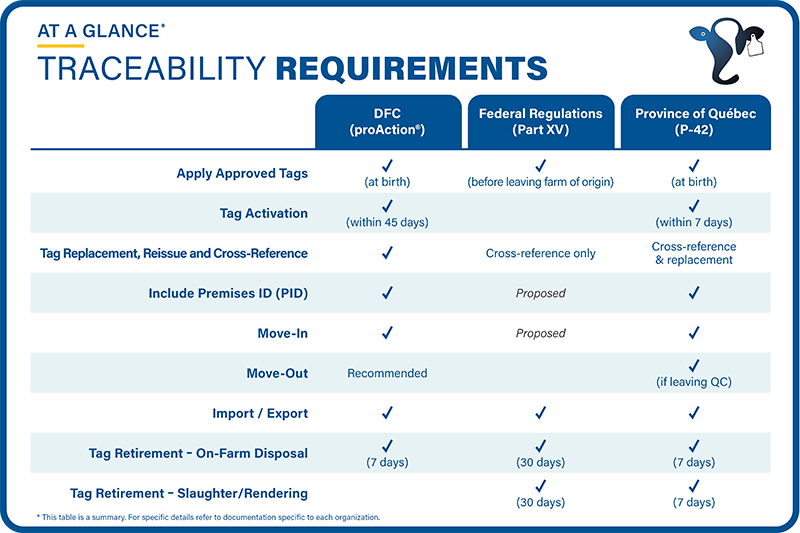
Reporting Traceability Events
When a proAction® validator visits your premises, they may ask to see animal records. All identification, movement and location information, including tag retirement, must be reported to DairyTrace and records must be kept for a period of five (5) years (10 years for farmers in Alberta).
Dairy producers and other stakeholders have various options for submitting traceability information. These methods may differ to respect government regulations in their respective province.
To find your best reporting option(s), please refer to our new Reporting Methods Guide for more details or contact DairyTrace Customer Services.
Jennifer Peart explains how reporting through DairyTrace has encouraged best practices on her farm
Premises ID
Connecting animals to geographic locations
Premises Identification (PID) is the assignment of a unique number to a location where agri-food activities occur.
Knowing where dairy cattle reside connects animals to geographic locations and supports faster response in an emergency.
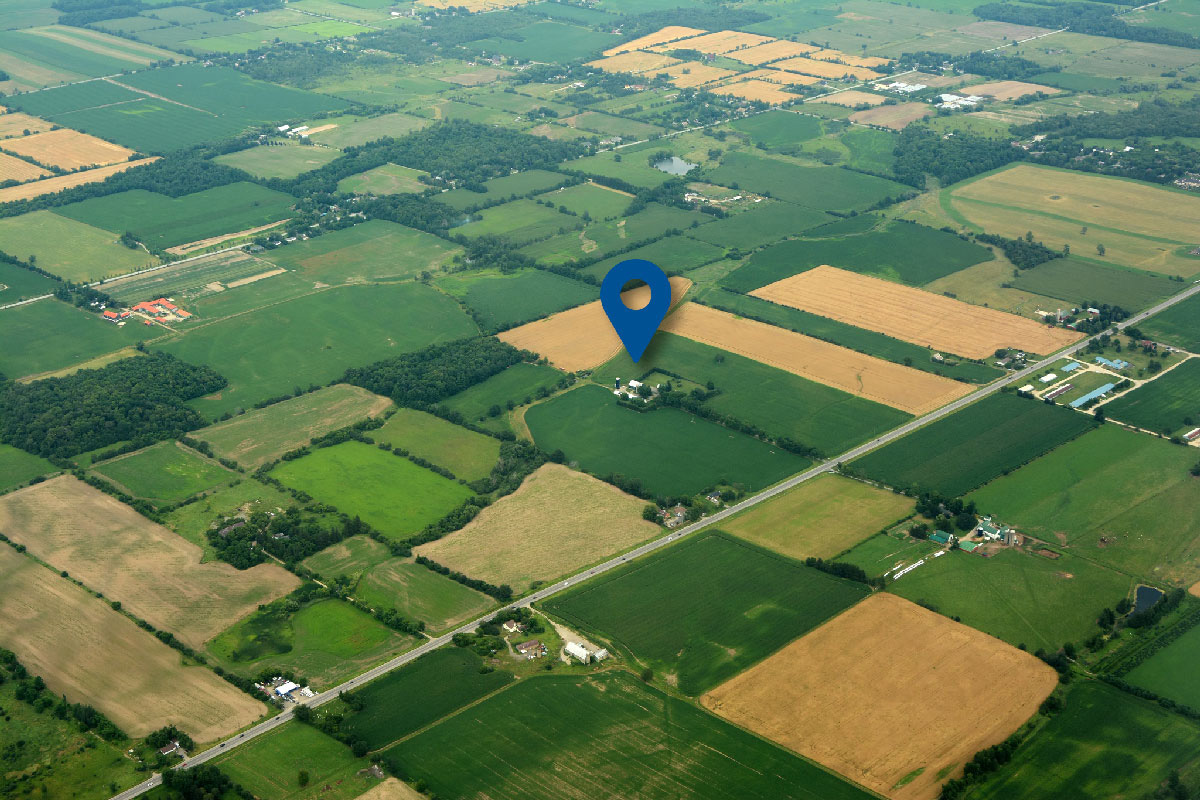

What is a Premises?
A premises is a location site on which animals are kept, moved through, or disposed of. Each site holds a seven-digit premises card that is georeferenced in the DairyTrace database.
A premises ID is:
- free to obtain
- linked for every site you declare (including your vehicle)
- used when reporting events to DairyTrace
- required when ordering tags
- issued by the provincial government
- essential when working with health and food safety officials
Who should register their premises?
Any person who houses livestock should register their premises. This includes, but is not limited to:
- Transport trucks
- Assembly yards / Pastures / Feedlots
- Veterinary hospitals / Insemination centers / Research facilities
- Abattoirs / Rendering plants
- Farms / Stables (livestock buildings)
- Auctions / Livestock facilities
- Exhibitions / Fair grounds / Competition facilities
- Zoos / Petting zoos
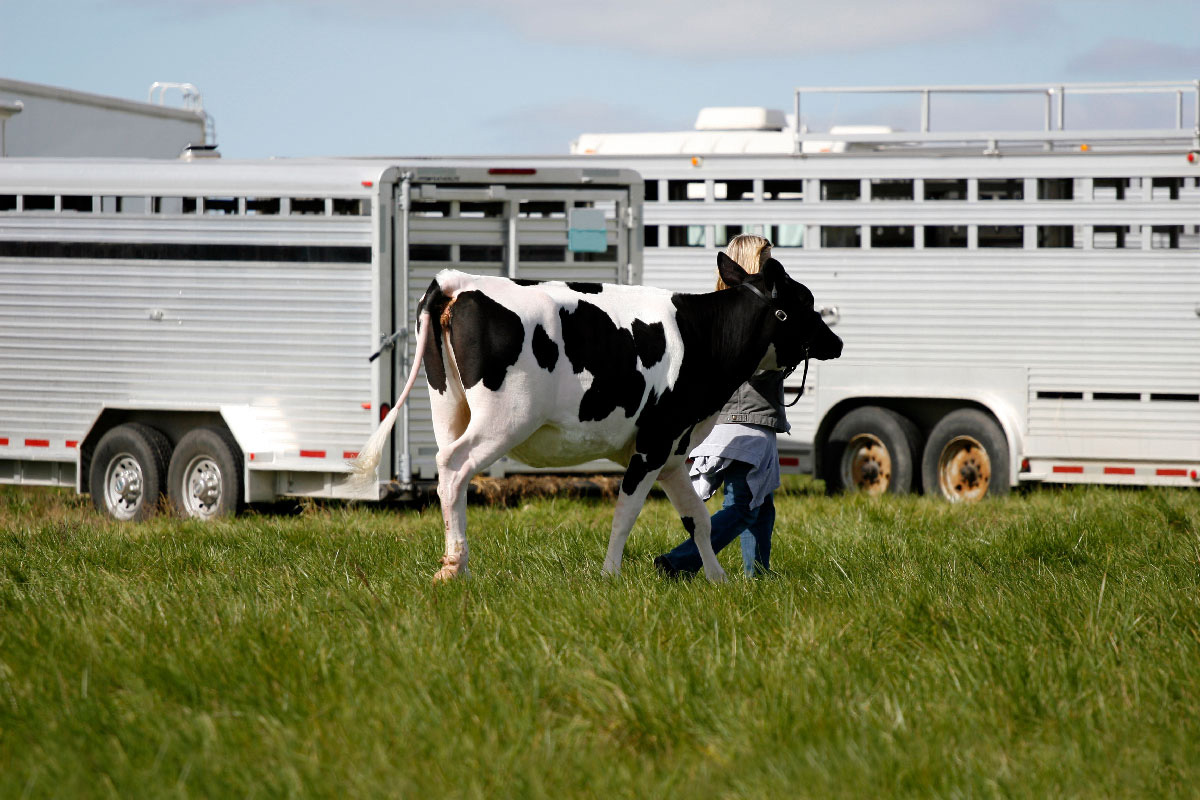

Where can I register for a PID?
Each province in Canada has a Provincial Premises Registry (PPR) that issues PIDs. For information on where to obtain a premises identification number and card, contact your provincial dairy organization.
Remember to share your PID on your DairyTrace account to help everyone easily report movement events.
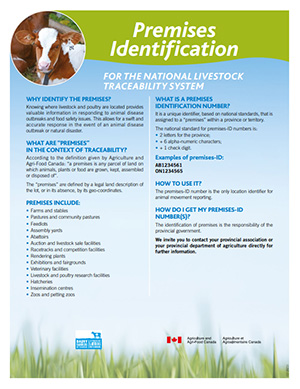
Tagging and Animal ID
All calves born on dairy farms across Canada are identified with a unique 15-digit ear tag that begins with the numbers “124”. This number stays with the animal for its entire life, meets international ISO standards, and is recognized by the Canadian Food Inspection Agency (CFIA).
Definition of Dairy Cattle:
Any bovine animal identified with an approved DairyTrace tag, which includes all those born on dairy farms validated through the proAction® program.
Learn how calves should be properly tagged
We depend on healthy livestock and it is feasible to contain disease and track its sources with a reliable traceability system. Rapidly identifying affected sites and animals can prevent disease spread.
Double Tagging
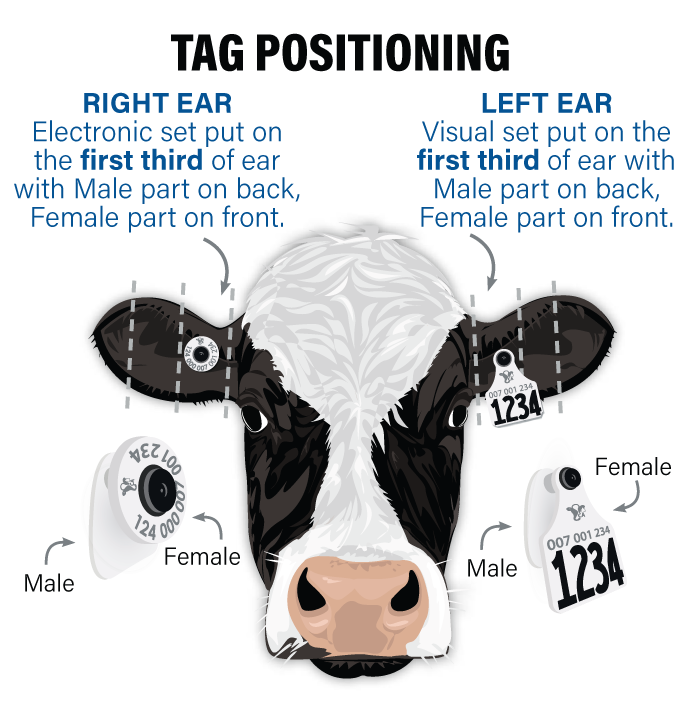
The ultimate goal of DairyTrace is double tagging of all dairy animals. Tagging your calves at birth provides an efficient way to permanently identify the animal with a unique number. Dual tag sets are comprised of an RFID electronic tag, ideally placed in the right ear of the animal, and a secondary panel tag placed in the left ear. This ensures that if an animal loses one tag, they can still be identified with the other, as well as having the capability to work with RFID technology and electronic tag readers.
Tag Activation/Birth Events
All newborn animals – male or female – are tagged at birth, recorded on-farm and then reported to the DairyTrace system;
Tagging on-farm is required within seven (7) days of birth or before the animal leaves the farm of origin, whichever comes first;
Premises ID, the 15-digit ear tag ID, and the animal’s date of birth are required;
Tags must be reported to DairyTrace (activated) within 45 days of the animal’s birth, or before the animal leaves the farm of origin, whichever occurs first;
It is recommended to activate the tags the same day that you apply them to the animal
Tagging for stillborn calves is not required if they are disposed of on-farm, however, tagging as well as reporting the tag activation, is required if they are leaving the farm to go to a rendering facility (who will record and report the tag retirement).
Resources for proper tag positioning
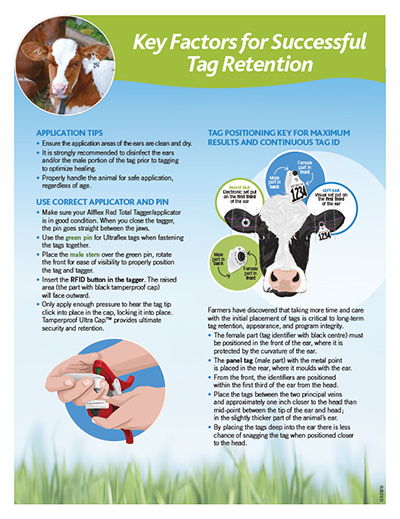
Successful Tag Retention
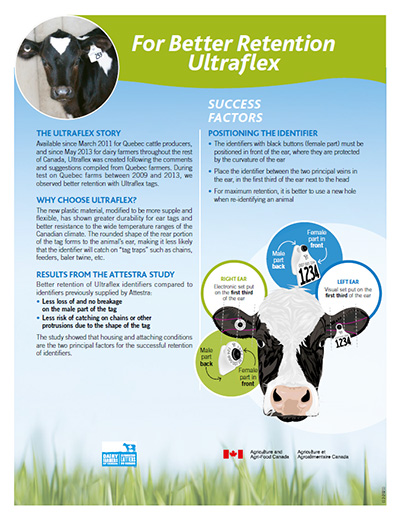
Ultraflex Better Tag Retention
Tag Loss Events
Properly double tagged dairy animals can move off farm anywhere at any time, however, when an animal loses their tag, it must be replaced and then reported
Tagging of Imported Animals from the US
“840” electronic dairy ear tags for animals born in the U.S. are acceptable forms of identification for animals imported from the United States into Canada. Canadian “124” tags are not required unless the animal loses its tag.
Quick and Easy Tutorials can be found here
Tag Re-issue
- If the same tag number can immediately be re-ordered, reporting is required once applied. Write the number on a generic tag (photo or sketch) until the re-issued tag is received and can be attached.
- If lost due to normal wear and tear, re-issues are free in all provinces except for animals originating from Quebec or the US.
Tag Cross Reference
- If an animal is re-tagged with a NEW number, recording and reporting is necessary within seven (7) days and must be cross-referenced to the previous known ID in the DairyTrace system.
- If the animal is American, imported from the United States, the lost US “840” tag must be cross referenced with the Canadian “124” number and both numbers must be reported to DairyTrace.
Tag Replacement
- If an unknown animal is re-tagged with a NEW number, recording and reporting is necessary within seven (7) days to activate the new tag in the DairyTrace system.
Animal Movement
Animal movement between two sites of different ownership (premises-to-premises) must be reported to DairyTrace and this includes transport trucks. In case of a disease outbreak or other emergency, officials can then identify exactly where the animal has been, other animals it has been in contact with, and where it is currently located.
The data collected by DairyTrace can help protect our economy by preparing us for challenging times, as well as strengthening the reputation of the Canadian dairy sector and its products, here and around the world.
Recording & Reporting Movements
When a dairy animal arrives at your farm, dairy producers must record and report the animal movement to DairyTrace for all events, including the:
- 15-digit animal ID number on the ear tag;
- Date of arrival (birth/move-in);
- Premises ID (PID) of the arrival and departure points, including, but not limited to, the license plate of a transport vehicle;
- All within seven (7) days of arrival or before departure, whichever comes first.
- It is a recommended good practice for farmers to record and report any animal departure from the farm. For affiliates (i.e. abattoirs, auction facilities, transporters, veterinarians, other) DairyTrace promotes the recording and reporting of all movement.
Movement & Retirement Events
Animal Move-in
When an animal arrives, it is the responsibility of the new premises to report the move-in event in Canada within seven (7) days of arrival. Suppose you take an animal to a show and then bring her back home, or your heifer is raised at another farm and returns home, in each scenario it is your responsibility to report when that animal moves back in.
For imported animals from another country, you will need the address from where the animal departed from and the vehicle/trailer license plate number, as imported animals will not have a recognized premise ID associated with the premises of origin in the other country.
Animal Move-out
When an animal leaves your farm within Canada, the new premises receiving the animal is required to report the animal move-in. This is specific to dairy producers but in the future is expected to also include auction houses, abattoirs, show grounds, community pastures, sorting centres, veterinarian clinics, etc. It is also recommended good practice that the departing premises make note of any move-out for their own internal records and report those events to DairyTrace.
Tag Retirement (Animal Disposal or Export)
Tag retirement confirms that the animal bearing the unique identification number has died or been exported and no longer needs to remain active in the national traceability system. Knowing that an ID number is retired saves valuable response time during an emergency.
Tag retirement must be recorded on-farm and reported to DairyTrace within seven (7) days of the event. If the tagged animals have died and are disposed of off-farm the rendering facility will report the retirement.
When exporting an animal to a destination outside of Canada, the movement must be recorded and reported to DairyTrace. This includes the location/address where the animals were exported to and the vehicle/trailer license plate number.

Connect with DairyTrace


DairyTrace
660 Speedvale Avenue West, Suite 101
Guelph, Ontario N1K 1E5
© DairyTrace 2026 | Contact Us | Media | Privacy Policy